Witnessing the Soul: Blog Posts

What I Didn't Know My Soul Was Carrying Into Courtship: A Personal Reflection
Most of us walk into the premarital season the way I once did, carrying almost nothing we actually need for it. We carry a checklist. We carry a sense of what our families expect, what our communities will quietly approve of, what age feels acceptable to still be unmarried at. What we rarely carry with us is any real understanding of our own emotional vulnerabilities, the attachment patterns we absorbed long before we ever sat across from a potential spouse, or what it actually takes to heal an old wound before it steers a new relationship from somewhere underneath our awareness.
We tend to treat courtship as a matching exercise. Right values, right background, right education, right family approval. These questions aren't useless, but they tell us almost nothing about what actually determines whether a relationship will be safe and sustaining, which is how two people handle closeness, conflict, and vulnerability once the excitement of matching wears off. Almost none of us enter courtship having asked what we're bringing into it from earlier relationships or from our families of origin. So we bring it in anyway, unexamined, and it shapes everything from underneath, the same way my unhealed shame from 2007 quietly shaped everything that came after it.

Muslims Have a “Body Problem,” and It's Not What You Think
After almost two decades of working with Muslims, in Muslim communities, and in my own healing, I can say this with confidence: we have a body problem. We are disconnected from our bodies, and most of us don't know it, because disconnection doesn't announce itself. It just looks like a short temper, a heaviness no sleep can touch, a flinch you can't explain, a flood of words you didn't mean to release. It looks like everything except what it actually is.

Why Treating Our Struggles as a Spiritual Deficit Gets in the Way of Our Healing
In my blog post last week, I named something I keep witnessing again and again, both in my work and in myself. That so many of us have been taught to respond to what feels uncomfortable by reaching for more knowledge, more rulings, more explanations, more understanding, as though enough of the right information could finally settle what we feel. And I named honestly that this has never actually worked. Knowing more about our sexual health has never, on its own, made anyone feel less afraid of their own body, or closer to their spouse, or more at peace with their sexual desire.
So if knowledge was never going to be the thing that met us, it is worth asking directly what actually is standing in the way. And the answer, at least in my experience sitting with people in this work, again and again, is discomfort itself. Sometimes that discomfort looks like confusion, not knowing what we feel or why. Sometimes it looks like anxiety, or shame, or anger that seems to come from nowhere. But underneath most of it, especially when it comes to our sexual health, is fear. Not a moral failing. Not a sign that our faith is weak or our character is flawed. Simply an emotion, doing what emotions do when they are left unmet for long enough.

The Muslim Habit of Treating Our Struggles as a Spiritual Deficit
Feeling seen is real, but it was never meant to be where things end
Think about what actually happens in your body when you watch that video or hear that friend's admission. Something loosens. You feel understood, maybe for the first time, and that feeling is powerful enough that it can be mistaken for resolution. But relief is not the same thing as repair. Being named is not the same thing as being witnessed all the way through. A single moment of recognition, however meaningful, does not undo years of fear around our sexual health, and it was never designed to.
What We Miss When We Talk About Women's Sexual Pleasure
An Islamic Lens on Pleasure
Within an Islamic framework, a woman's sexual pleasure is not an afterthought. It is something our tradition takes seriously, from the emphasis placed on foreplay to the language scholars have used around a husband's responsibility to attend to his wife's pleasure and not only his own. This is a tradition that understood, long before modern sex therapy existed, that pleasure is not incidental to intimacy but central to it, and that rushing toward an endpoint dishonors what intimacy is meant to hold.
This matters because it gives us permission, as Muslim women, to expect more than many of us were raised to expect. Sexual pleasure is not indulgent. It is not something to feel guilty for wanting. It is something our tradition asks to be honored within marriage, held with the same seriousness as any other part of the relationship.

Overcoming Vaginismus Is Not the Same as Healing From It. And Why This Changes Everything.
Here is what rarely gets spoken about, even among women who have done the hard, courageous work of moving through vaginismus and into pain-free intercourse. Many of them still do not feel sexual desire. They still do not feel arousal. They still do not feel pleasure.

The Myth of Sexual Compatibility. And Why It’s Something You Can’t Determine.
When people talk about sexual compatibility in the premarital stage, they're usually reaching for something specific, even if they don't say it in these exact words. They want to know whether their levels of sexual desire will match. Whether “sexual preferences” align. Whether two people's sense of pleasure and closeness will fit together neatly enough to predict a good marriage. Underneath the question sits a quiet assumption that almost no one examines: that these things can be known in advance, assessed in a conversation, compared like two answers on a form.
Sexual Desire is an Emotion. And This is Why Many of Us Struggle With It.
Sexual desire is an emotion.
And it exists with our other emotions, too — grief, joy, anger, anxiety, and more.
The room went still in the way a room only goes still when something true has landed. Not the stillness of people learning something new with their minds, but the stillness of people being witnessed inside something they had been carrying alone for a long time — some of them for years, some of them since before they can remember.
That stillness is the reason I'm writing this.

Waiting to Be Witnessed: When Sexual Intimacy in Marriage Feels Disconnected
In their intimacy, Sarah is present. She shows up fully, she has never withheld herself, and by every outward measure she is a willing and engaged wife. And yet sexual pleasure — the kind that rises unbidden from somewhere within her, rather than something she performs or offers — has never once arrived. Quietly, in the parts of herself she rarely lets anyone witness, she has begun to wonder whether the absence means something is wrong with her.
Earlier in their marriage, Hamza found himself turning to pornography, on and off, in the way so many husbands quietly do without ever naming it to another soul, sometimes without fully naming it to themselves. It was never about loving his wife any less. It was that something in him had gone searching — for relief, for escape, for a kind of connection he did not have words for and had never been taught to look for anywhere else.
What matters most in all of this is that none of it was ever really about sex. The scrolling and the tidying, the distance that settles into their evenings, the pleasure that has never arrived for Sarah, the pull Hamza has felt toward pornography — these are not separate struggles living in separate corners of the marriage. They are the same disconnect, wearing different faces, surfacing wherever it can find an opening. What shows up in their sexual intimacy is not the wound itself. It is the place where the wound has finally become visible enough to be named. The roots reach back much further — into what each of them absorbed, long before they ever knew one another, about closeness and worth and what was safe to want and safe to feel out loud.

Rethinking “Pornography Addiction” among Muslims: An Islamic and Soul-Centered Path to Healing
Rethinking “Pornography Addiction” among Muslims: An Islamic and Soul-Centered Path to Healing

Naming the Gap: When Islamic Reminders Don’t Meet Our Emotional Reality
Spiritual bypassing is when we use religious or spiritual teachings to avoid facing our emotional pain. It’s when reminders become a shield against vulnerability, instead of a doorway into deeper intimacy with ourselves and with God.

Witnessing my Soul: Who Held Me This Year
At the heart of this is a spiritual truth I return to often: before any human being witnesses us, we are already seen. In the Islamic tradition, there is an awareness that God witnesses not only what is visible, but what is carried inwardly — the intentions we don’t articulate, the efforts that go unnoticed, the quiet forms of endurance that never make it into language. This awareness is not meant to weigh us down; it is meant to steady us. And yet, God’s mercy so often reaches us through people. Through teachers, companions, communities, and relationships that become vessels of care. Being witnessed by others is not separate from being witnessed by God — it is often one of the ways that care takes form in our lives.

Two Muslim Moms, Their Sons, and Secret Girlfriends—And The Soulful Islamic Approach We’re Missing
Recently, I came across a video on YouTube titled “How Two Muslim Moms Dealt With Their Sons’ Secret Girlfriends.” On the surface, it held the possibility of nuance. Two scenarios. Two families. Two sons crossing a boundary their parents had hoped they wouldn’t. It felt like an opening — perhaps an invitation to finally explore the emotional, developmental, and spiritual terrain that shapes why Muslim teenagers struggle in the first place. Not simply what they did, but what their actions meant. What needs they were trying to meet. What their hearts were aching for and didn’t know how to articulate.

I Thought I'd Always Be The "Sexual Health for Muslims" Expert. Then I Discovered What Was Beneath.
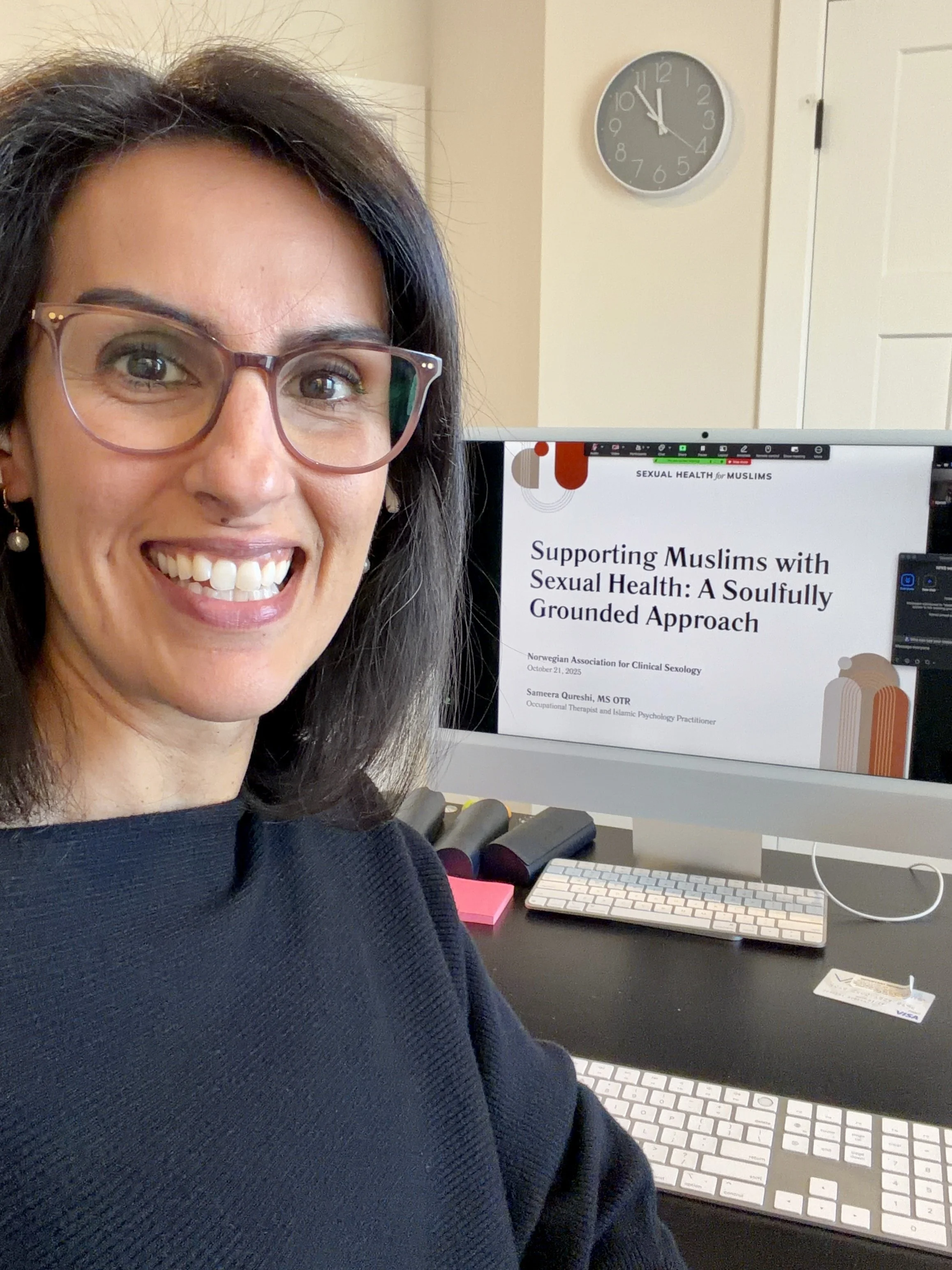
When I began this work, I believed I was addressing sexual health for Muslims. And I was. I spent 17 years developing curricula, training educators, holding space for difficult conversations, and helping Muslim communities navigate topics that had been pushed to the margins or avoided altogether.
But somewhere along the way—through my studies in Islamic Psychology, through my own healing journey, through writing a book that centers Islamic traditions of the soul for sexual health, and most recently through completing Level 2 Shifaa Method training—I began to see something I couldn't unsee.
My work has naturally focused on the soul. It's the direction I've been pulled in, the depth I've been called to explore. And now, I need to deepen even further.
Sexual health issues aren't just sexual health issues.
They're doorways. They're invitations. They're the surface ripples of something much deeper happening beneath—in the qalb, the heart, the very center of our soul.

I wrote my book “Soulful Sexual Health for Muslims” after 17 years of soul work. Before I could teach it, I had to walk it.
I’ve been sitting with something uncomfortable lately—something I didn’t expect to feel so strongly as I approached my book’s preorder date. Soulful Sexual Health for Muslims is the first of its kind, and that should feel exciting, right? And yet, as I think about how to share this with the world—how to promote it, how to invite people into its pages—I feel stuck. Not because I don’t believe in it. I do. I believe in it with every part of me. But because the usual approach to marketing a book doesn’t fit. I didn’t write this book from a place of strategy or sales funnels. I wrote it from the depth of my soul, from years of holding pain—mine and others’—and from a quiet, determined commitment to keep doing the inner work.
So the question I’ve been asking myself is: How do I promote something that isn’t just a book, but a reflection of my own journey?

The Muslim Mental Health Field’s Obsession with Cognitive-Behavioral Therapy (CBT): Why We Must Return to the Soul
There’s a growing movement to make therapy more accessible and accepted in Muslim communities—a long overdue effort to break the stigma around mental health. But in the rush to validate therapy within an Islamic framework, one model has taken center stage almost unquestioned: Cognitive Behavioral Therapy (CBT). Praised for its practicality and intellectual appeal, CBT has become the go-to modality in Muslim clinical spaces. But what if, in our effort to make therapy seem familiar, we’ve unknowingly distanced ourselves from the heart of our own tradition? This article explores the deeper costs of centering CBT in Muslim mental health—and invites us back to a soul-rooted, spiritually honest model of healing.


Sexual Intimacy in Muslim Marriages: The Problems with Centering the “Right to Sex”
The following are six nuanced points that Muslims must keep in mind with regards to soulful marital sexual intimacy, and why Muslim struggle with it, for legitimate reasons.