Naming the Gap: When Islamic Reminders Don’t Meet Our Emotional Reality
Last week, while posting content to my Instagram story, I did something I don’t always do: I lingered. I clicked through posts from Muslim professionals, organizations, and everyday people, curious about what conversations were unfolding across our communities. Then I opened the comments — and that’s when something caught my attention.
It wasn’t just the words themselves, but the patterns emerging between them.
I saw people trying to talk themselves into being okay. Trying to be “strong.” Trying to use reminders about patience, gratitude, and trusting God as a way to push down what they were actually feeling. As I kept reading, I felt a softness rise in me… followed by a familiar ache. Because beneath the sincerity of those comments, I could sense how many of us are quietly wrestling with emotional pain — but without the tools or language to name it.
There is no shortage of Islamic content that centers thoughts and behaviors: reminders to be grateful, to stay patient, to renew our intentions, to trust God. These reminders carry beauty and wisdom, and they offer spiritual truth. But the way they’re often presented — and the way we’ve learned to apply them — keeps us in our minds, focused on what we should be thinking or how we should be behaving. Without realizing it, we end up policing our inner world instead of turning toward it.
This mirrors a broader pattern I’ve seen across Muslim mental health spaces as well: a strong emphasis on cognitive approaches, particularly cognitive behavioral therapy. The focus becomes correcting thoughts, adjusting behaviors, and trying to mentally “shift” our way out of difficulty. And while these tools can be helpful in certain situations, they often fail to reach the deeper layers of emotional truth held within our hearts and bodies.
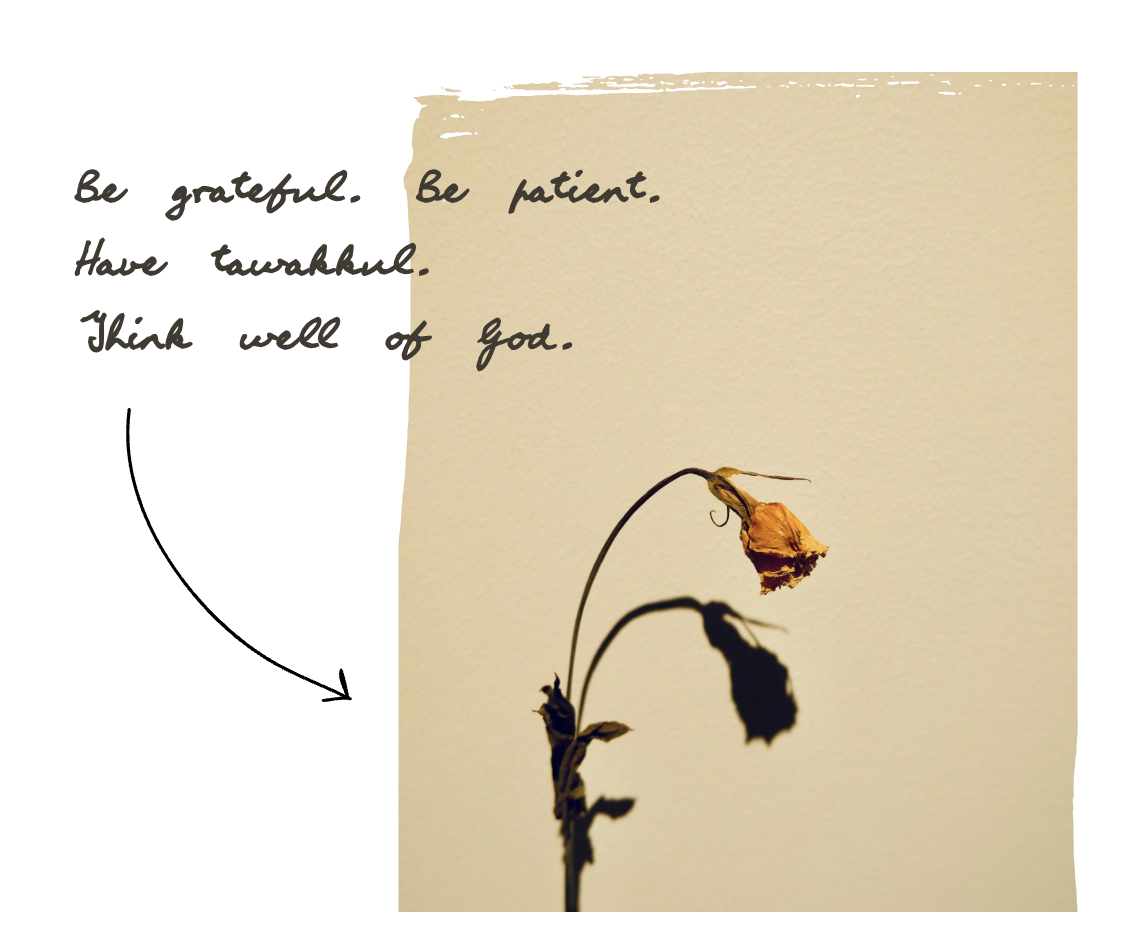
So many of us — sincerely wanting to be spiritually grounded — take these reminders and apply them literally to every part of our lives.
Be grateful.
Be patient.
Have tawakkul.
Think well of God.
But underneath this, something more tender is happening. We begin bypassing our emotional reality. We rush past sadness, overwhelm, anger, disappointment, or loneliness because somewhere along the way, we learned that feeling these emotions might mean we’re weak in faith. We try to force ourselves into spiritual states we aren’t actually in.
And when the reminders don’t “work,” when our hearts still feel heavy or disconnected, a painful inner cycle begins:
Why can’t I feel grateful?
Why do I still feel so far from God?
Is God upset with me?
What does this say about my faith?
In these moments, what was meant to comfort us can deepen our struggle. Instead of drawing us closer to ourselves and to God, these reminders can push us further into our minds — searching, analyzing, trying to fix — while the heart waits quietly for someone to turn toward it. This is where the concept of spiritual bypassing becomes important.
Spiritual bypassing is when we use religious or spiritual teachings to avoid facing our emotional pain. It’s when reminders become a shield against vulnerability, instead of a doorway into deeper intimacy with ourselves and with God.
And I want to say this clearly: spiritual bypassing is not a moral failure. It’s a response that emerges when we’ve never been taught another way — when our communities have emphasized thoughts and behaviors, but rarely taught us how to companion our own hearts. And yet, it is the heart (qalb) that holds both our emotions and God’s presence, carried through the ruh (spirit).
Over the coming weeks, I want to gently explore a different way of understanding struggle — one that honors the emotional, spiritual, and embodied realities of our lives. Next, I’ll share what I call a soulful reframe of struggle: a way of seeing difficulty through an Islamic worldview that centers the entirety of the soul, not just the mind.
For now, you might pause with these reflections:
Where do I notice myself turning to reminders instead of turning toward what I’m actually feeling?
What emotions have I quietly dismissed or minimized in the name of being “strong” or “spiritually grounded”?
If you’re ready to dive deeper into witnessing your soul, you may want to explore therapy or guidance sessions, my Soulful Sexual Health for Muslims book, or sign up for my newsletter using the form below.
