
Image from Unsplash’s free collection
I wrote recently about how sexual desire is an emotion, how it moves through the same heart, the same imprint, the same nervous system as everything else we carry, shaped by a soul's history rather than by any fixed formula. If you haven't read that piece yet, it's worth starting there, since everything I want to walk through here grows directly out of it.
Once you understand sexual desire as something dynamic, something that shifts with imprint, with context, with whatever else a person is holding in a given season of life, a very specific myth starts to come apart at the seams. This is a myth I hear constantly in the premarital stage, dressed up as practical wisdom, as due diligence, as the responsible thing any thoughtful person should ask before committing their life to someone. The question sounds reasonable enough on the surface. Shouldn't we know if we're sexually compatible before we get married? It sounds like care. It carries the feeling of protecting yourself from a future you can't yet see.
What I want to walk through is why that question, however sincerely it's asked, was built on a foundation that was never actually there to begin with, and what becomes possible once we stop asking it.
What We Mean When We Say "Compatible"
When people talk about sexual compatibility in the premarital stage, they're usually reaching for something specific, even if they don't say it in these exact words. They want to know whether their levels of sexual desire will match. Whether “sexual preferences” align. Whether two people's sense of pleasure and closeness will fit together neatly enough to predict a good marriage. Underneath the question sits a quiet assumption that almost no one examines: that these things can be known in advance, assessed in a conversation, compared like two answers on a form.
Sexual desire was never a fixed quantity sitting still inside a person, waiting patiently to be measured and reported back. We've already spent time establishing this. Sexual desire is dynamic, moving with emotional connection, with stress, with healing, with trust, with the particular season a person happens to be standing in when you ask them the question. There was never a stable number to compare in the first place, no matter how carefully either person tried to answer. Asking whether you're sexually compatible before marriage resembles asking whether you're compatible with someone's mood on a given afternoon. Real enough in that moment, and unable to tell you anything true about the years still ahead.
This isn't only a misunderstanding of how sexual desire works. It's a misunderstanding that costs people something real. Connections end too soon. Boundaries get crossed before they should be. Years of a marriage pass in quiet fear of a difference that was never actually a warning sign.
What This Myth Actually Sounds Like, Long Before Anyone Names It
This myth rarely announces itself. It almost never shows up labeled, wearing something obviously wrong. Instead, it appears disguised as honesty, as two people trying to be modern and transparent about something that genuinely matters to them. I want to be clear about something here too, since this myth doesn't belong to one gender the way it's often assumed to. Women reach for these same questions just as often as men do, looking for the very same false reassurance.
Sometimes it sounds like asking a potential spouse directly about sexual preferences that were never meant to be discussed outside of marriage. Other times it sounds like questions about sexual fantasies, estimated frequency of sexual intimacy, or past sexual experiences, framed gently as simply getting to know one another. It can sound like sexting, quietly justified as testing chemistry, as though chemistry were something that needed to be proven in advance rather than something discovered slowly, inside a shared life. Pressure to disclose past experiences can show up too, offered as a way of gauging fit.
Each of these exchanges tends to get defended in the moment as progressive, or necessary, or simply honest, the kind of conversation any two mature adults should be able to have before marriage. None of them are actually that. They cross a boundary that exists to protect both people, and in crossing it, they quietly pull the entire premarital process away from what it was always meant to be. A discernment of the soul, of character, of values, of how someone treats the people around them when nothing is being tested, slowly becomes something closer to a screening of the body.
Where This Myth Comes From
No one arrives at this myth entirely on their own. It gets absorbed, quietly and persistently, the same way we absorb almost everything about sexual desire, as I wrote in the last piece. Piece by piece, from wherever it happens to show up. Social media frames sexual intimacy as a performance to be evaluated and compared. Peers repeat something they heard secondhand, already several steps removed from anything true. Past relationships leave an impression about what intimacy is supposed to look like, an impression carried forward without anyone ever examining it. And pornography, often, offers a version of sexual desire severed entirely from the rest of a person's soul, so physiologically inaccurate and so spiritually hollow that it bears almost no resemblance to what two people actually build together over years.
There's a distinction worth sitting with here, between shahwah and ruh, between the desiring dimension of the self and the spiritual one. Shahwah (sexual desire) isn't something to carry shame over. It was placed within us on purpose, woven into our nature the same way every other emotion was, with wisdom behind it even when we can't immediately see that wisdom ourselves. When shahwah gets severed from ruh, from the soul's deeper alignment with something larger than the moment, something shifts. What was meant to be channeled starts to simply drive. This is close to what the Quran names as the nafs al ammarah, the self that pulls toward whatever feels satisfying right now, untethered from anything deeper, from anyone else's wellbeing, from where any of it is actually leading. None of this makes the nafs al ammarah evil. It is simply unanchored. And the myth of sexual compatibility is very often the nafs al ammarah doing the asking, quietly reducing a potential spouse to a checklist of what they can offer physically, feeding an anxiety underneath all of it that rarely gets said out loud. Will I be enough. Will they meet what I need. What if I find out too late that we don't fit.
That anxiety was never supposed to have a seat at the table where you discern a life partner.
What This Myth Actually Costs
In the premarital stage, this myth pulls conversations somewhere they were never meant to go, into territory that belongs, if it belongs anywhere before marriage at all, much later than most people realize. Genuine connections end prematurely because of it, over a measurement that was never accurate to begin with. Someone gets dismissed not because their character or values were misaligned, not because the marriage itself would have struggled, but because of a standard that couldn't have predicted anything real in the first place.
For those already married, this myth doesn't simply disappear once the nikah has been completed. It changes shape instead, settling somewhere quieter. A private fear takes root, the fear that a difference in sexual desire between spouses means something is fundamentally broken, that the marriage has already failed some test neither partner remembers agreeing to take. That fear is common, and it is also, almost entirely, unnecessary. Differences in sexual desire between spouses aren't evidence of failure. They are the norm rather than the exception, expected across a shared life long enough to move through illness, exhaustion, stress, new children, grief, distance, settling into married life, past trauma, and everything else that shapes how a person experiences their own body over time. The myth leaves couples without language for what they're actually living through, and without real hope that what feels stuck right now could still shift.
What's True Instead
The myth insists that compatibility is something you arrive at, a destination reached before the wedding and checked off a list. The truth is something considerably more hopeful. Intimacy is something you grow.
What actually predicts real, lasting satisfaction over the life of a marriage was never a checklist filled out in advance, regardless of how honest either person tried to be while filling it out. Emotional safety, built slowly over ordinary days, matters more. So does honest communication, practiced again and again until it stops feeling like a risk. So does the willingness of two people to remain curious about each other, responsive to each other, as they continue changing, because they will change, over and over, across every season of a shared life, in ways neither of them could have predicted on the day they got married. None of that can be tested before the Nikah. All of it gets built, patiently, after it.
This is where something like my Soulful Model of Sexual Intimacy (view figure below) becomes genuinely useful, the understanding that sexual intimacy rests on three dimensions held together at once: emotional, physical, and spiritual. Each one matters. None of them is sufficient by itself. The myth of compatibility only ever asks you to examine one of the three, the physical, while leaving the other two almost entirely unexamined, as if they weren't the ground everything else grows from. A guide that only sees one circle out of three will always miss the fullness of what soulful intimacy actually requires to take root.
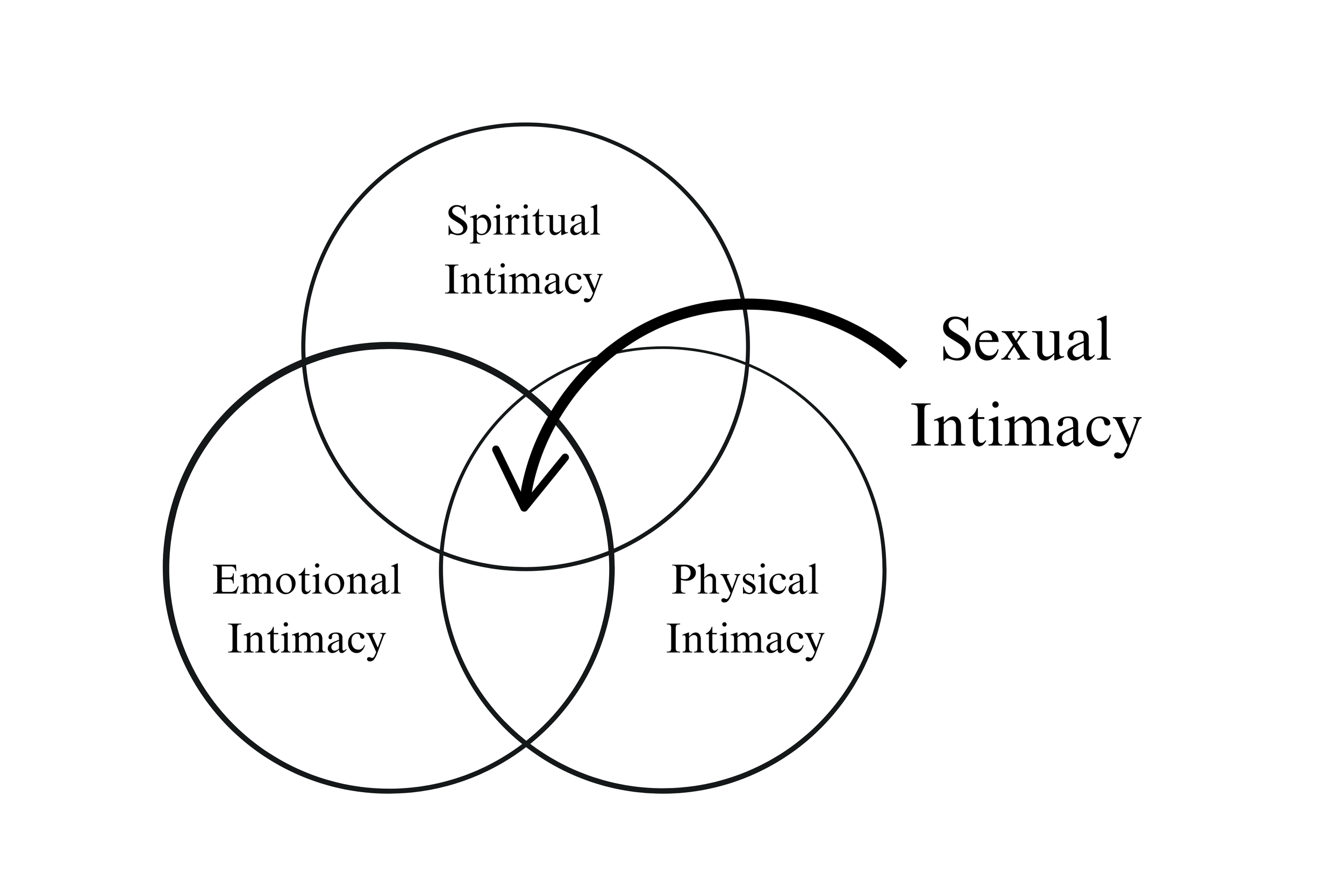
My Soulful Model of Sexual Intimacy, as published in my Routledge (2025) book, Soulful Sexual Health For Muslims
What Actually Belongs in the Premarital Stage
None of this means sexual health has no place in premarital conversation. The kind of conversation matters enormously, and it changes depending on where two people actually are in the process, something the myth never bothers to distinguish.
Early on, while you're still discerning whether there's enough shared connection and shared values to move forward at all, the only conversation about intimacy that belongs is a conversation about commitment. A shared commitment to keeping things emotionally and spiritually centered, and to reserving physical intimacy for marriage, exactly as it was always meant to be reserved. As trust deepens and the relationship moves toward more serious discernment, conversations can begin to gently touch on readiness, on any relevant health considerations, on fears either of you may be quietly carrying, always in the spirit of understanding one another more fully rather than assessing or comparing. Only once the decision to marry has genuinely been made, in the preparation stage that leads directly to the Nikah, do the more direct conversations belong. Conversations about values, about concerns, about what each of you may need to unlearn together, about what you both want sexual intimacy within your marriage to actually mean, once you're finally free to explore it.
Each stage protects something specific and worth protecting. Moving too quickly toward the physical, at any point before it truly belongs, is exactly what the myth quietly encourages, and exactly what tends to cost people the most, whether they realize it in the moment or only much later.
Where This Leaves You
Sexual intimacy was never something you could determine in advance, regardless of how many honest conversations you had or how thoroughly you tried to prepare for it. It isn't a test you pass or fail somewhere before the wedding. It's something you grow, together, inside the marriage itself, through presence, through mercy, through the ordinary, unglamorous, deeply worthwhile work of staying curious about someone who keeps changing, year after year, long after the wedding photos have been put away.
If you came to this piece still carrying some version of that old question, are we compatible enough, sit with a different one in its place. Do we have what it takes to build this together, honestly, even when the answer isn't yet known? That question isn't smaller than the one you started with. It may be the only one that was ever actually going to matter.
If this piece left you wanting to go further than a single post or guide can take you, there are a few paths forward.
Season 1: Intimacy in Marriage begins soon, and the best way to hear the first details is to sign up for the newsletter (view sign-up section below).
If you're navigating something more specific, whether that's premarital discernment, a struggle already present in your marriage, or something you've been carrying quietly for a while, therapy and guidance sessions are both available as spaces to work through it directly.
For a fuller exploration of everything sexual health related, from puberty to sexual desire to intimacy after marriage to healing sexual trauma to soulfully teaching children about their sexual health, my book Soulful Sexual Health for Muslims (Routledge, 2025) is where all of this (and more) lives.
And if the question of what marriage actually owes two people around intimacy feels like it needs its own conversation, I wrote about that a while back: Sexual Intimacy in Muslim Marriages: The Problems with Centering the “Right to Sex”, a piece worth reading alongside this one.
