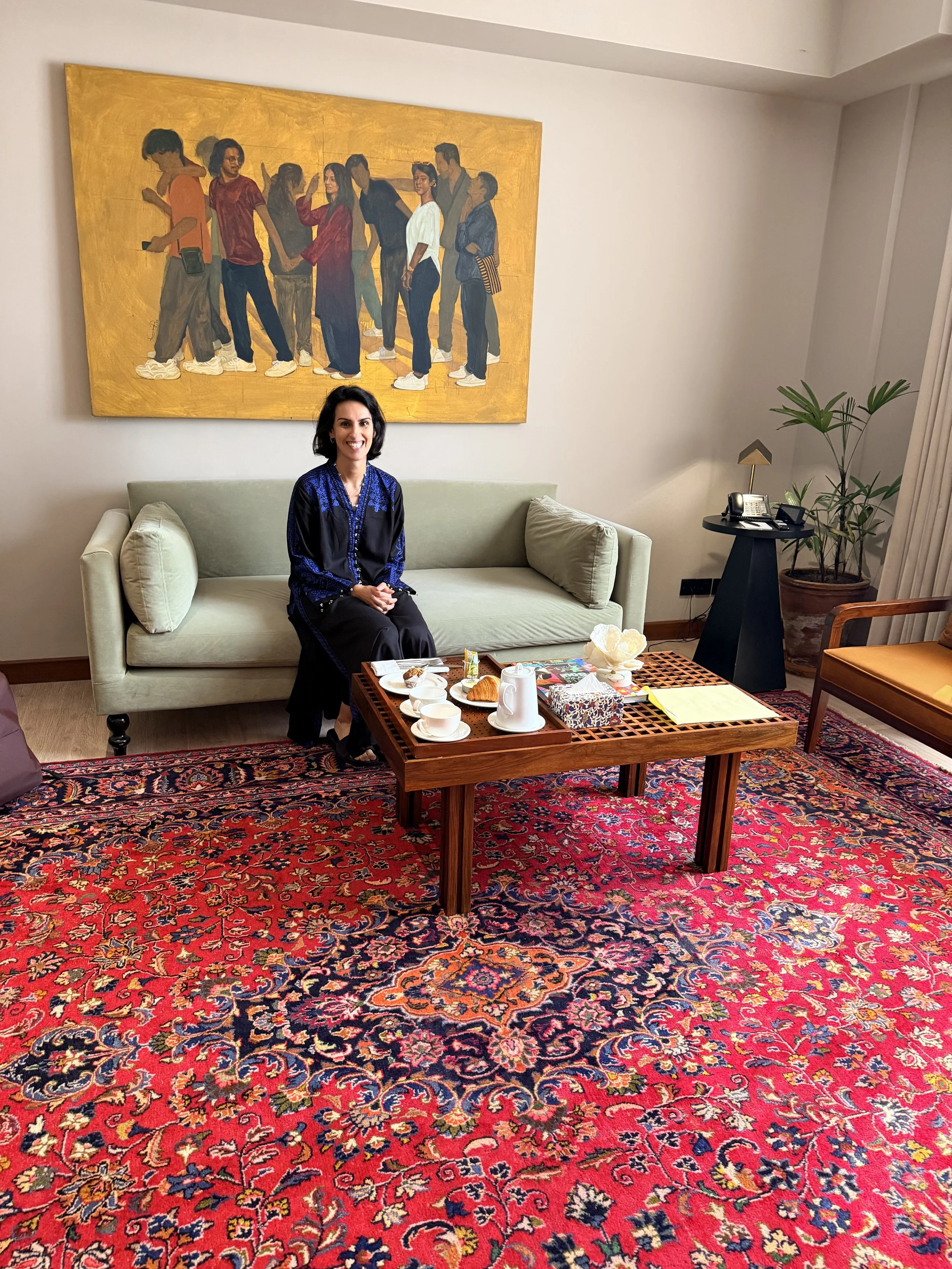
The moment I stepped outside the Lahore airport, the city met me all at once.
Smog softened the air and left a faint haze at the back of my throat. Voices overlapped from every direction, with horns rising above them, while families pressed forward in giant, joyful crowds to receive their own. This was my first time in Lahore, and still nothing about it overwhelmed me. Instead, a wave of familiarity moved through me, as though my body recognized what my mind had never been taught. My desi genes woke for the first time since I was eight years old and visiting Islamabad, a vastly different city from this one.
After ten days in Lahore, a grounded calm and an open-heartedness have taken root in me. I have realized that I feel more at home here than I do in the United States. Here I look like most of the people around me, and I dress as they do. Each greeting begins with my right hand on my heart, the warmth of my palm resting over its steady beat, as I say "Assalamu alaikum" and then "Aap kaise hain?" It does not matter whether I am greeting a security guard, hotel staff, or our driver. Eyes meet, faces soften, and every person is received in the same way, seen and appreciated. Between us passes something that moves beyond words.
It is the language of the soul.
Before this trip, which had been quietly taking shape for a couple of years, I carried a good deal of fear and uncertainty. Would I fit in? I do not look like the typical desi, with my shorter hair and my height, and I speak neither Urdu nor Punjabi. We rarely travel internationally, and we had never spent weeks in a city I had not yet seen, so a knot of nerves had settled in my chest long before the flight. I understood that fear as a natural companion to a journey like this one, and I let it travel with me rather than push it away. What I found instead was warmth, and a settling I had not expected.
Part of my preparation was learning some Urdu, and someone suggested I watch a Pakistani drama. At an event in June, a particular title was mentioned. All I could recall was that it began with a Z, so I searched and landed on Zanjeerain as the likely one. Pulling it up on YouTube, I began with the episodes I had missed, the subtitles scrolling beneath the faces while the rhythm of Urdu filled my ears. I fell in love with it. I loved the way the characters grew, and the way the Islamic and cultural context was woven in so naturally that it never felt explained. Soon I caught up to the live episodes, and I would fume on Wednesdays and Thursdays when new ones aired without English subtitles. The Instagram crowd felt it too and left scathing comments beneath HUM TV's posts. When the series ended, my heart broke a little. It was my first immersion in Pakistan, and it reached me through a screen long before I arrived in person.
Then, on the day we arrived in Lahore, I walked into Al-Fatah supermarket, tired and wide-eyed, and gasped at a picture of Sher Dil Lala, the actor Ahsan Khan. "I KNOW HIM!!!," I wanted to shout, though I kept it inside. Later, driving through Lahore, I looked up from the traffic and recognized the actresses Sajal Aly and Sahar Hashmi on the billboards, their faces larger than life above the street. It may seem small, but I felt a quiet pride at knowing who they were, even if only from the screen, of course.
Perhaps, I thought, I fit in more than I had feared.
Meeting family and new people each day has been its own gentle education. I have felt free to be myself: open-hearted, warm, offering my "I see you" vibe in broken Urdu and simplified English. My laughter fills the room, and my smile stretches as wide as it naturally does, until my cheeks ache with it. I joke, I ask questions, and I feel like me, and also like a version of me that the US rarely gets to meet.
There are moments when I have to stop and let it sink in that I am doing the very thing I was so afraid of. In those pauses I know that God is woven through this experience, present in the hearts of the people I meet. I feel Him in the steam curling up from each cup of chai, with its warmth moving into my palms. I feel Him in the laughter we share, and in the hand placed over the heart with a soft "shukriya."
With the days I have left, I want to go deeper. Being in Lahore has stirred a longing to meet the city through its heritage, and to come close to the hands that have shaped it over generations. I hope to spend my time among traditional crafts and arts, and to stand within the grandeur of the mosques, forts, and walls that hold this city’s memory. I want to feel the weight of fabric between my fingers and notice the texture of a weave, the depth of a dye, and the patience that lives inside every stitch. In the same way, I want to rest my palm against aged stone, to follow the lines of an arch with my eyes, and to feel how much devotion was gathered into every wall. The hands that wove the cloth and the hands that raised the stone were guided by the same care, and each carries a story of lineage. I am learning that my own story is part of that same fabric, and to touch it, thread by thread and stone by stone, feels like another way of coming home.
I carry so much gratitude for meeting this side of my lineage at this stage of my life. A part of me that had been waiting, perhaps without my knowing, has been welcomed home, and my soul feels much more complete.
I also carry a lesson from this journey that I did not expect to learn so tenderly. On the other side of fear is expansiveness. I could not have known this from a distance, because it is not something fear allows us to see from where it stands. We come to know it only by accompanying the fear in the moment, staying beside it as it trembles, and taking the next step with it rather than waiting for it to leave. Only then do we arrive on the far side, where the heart has more room than we imagined, and where the world, and our own soul, open wider than we thought possible.
