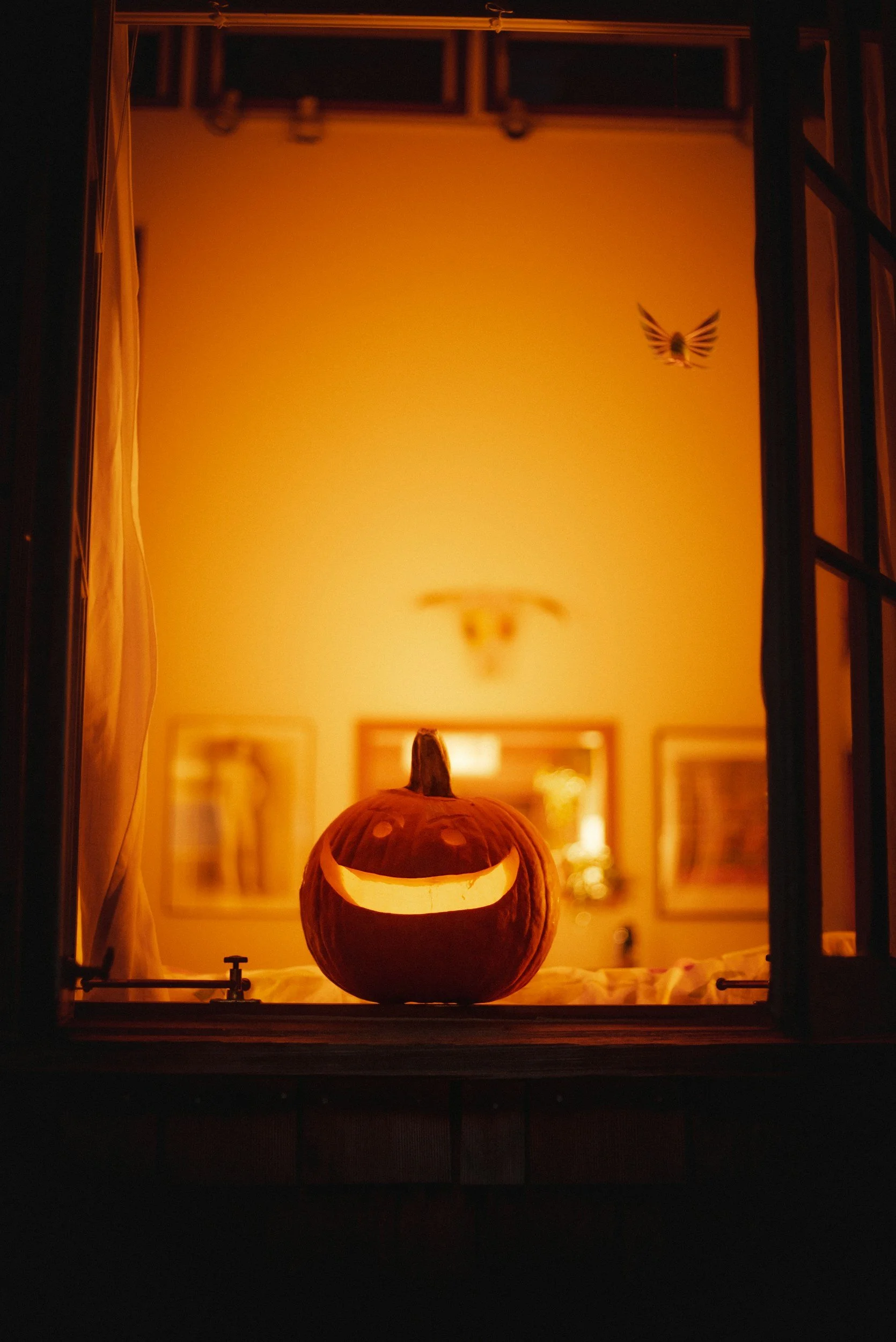
Fear has been on my mind lately. Perhaps it is the abundance of Halloween décor appearing around our neighborhood, with skeletons on porches and cobwebs stretched across hedges, or perhaps it is a theme I keep noticing in my work with clients and in my own time sitting with myself. Whatever the source, fear seems to be everywhere right now, and it feels fitting to talk about it on a day devoted to being scared.
Fear is one of the most universal emotions we share, and yet the way we speak about it tends to follow a familiar script. We are told to face our fear, to have no fear, or to “do one thing every day that scares you,” a line made famous on those previously popular Lululemon totes scattered with manifestations. These slogans are well intended, but they are clichés at best and unhelpful at worst, because none of them speaks to what fear actually needs. Fear does not need to be conquered, outrun, or dared into submission. It needs to be witnessed.
The Tricks Fear Plays
Part of what makes fear so fascinating is how rarely it appears as itself. Often it disguises itself underneath anger, letting the louder emotion take the stage while it hides in the wings. It can flow quietly through the mind as a steady stream of self-deprecating thoughts that sound a lot like honesty. Fear also dresses up as caution and overwhelm, so convincingly that we mistake it for good judgment, and it can turn itself into a believable story with a clear beginning, middle, and disastrous end. Then, in a voice that sounds very sure, it tells us that we are right and that this thing really is too much for us.
Fear also does something more insidious. It makes us believe that the fear we feel is due to the thing we are scared of, whether that is a difficult conversation, a diagnosis, a big decision, or a season of uncertainty. When we look closer, though, the reason so many of us feel fear in the first place is that we doubt our capacity to navigate the thing.
I will say that again because it matters. The fear is not really about the thing itself, and it is instead a reflection of our doubt that we can move through it and work with whatever unfolds. Consider the person dreading a hard conversation with a spouse. They are rarely afraid of the words themselves, and are more likely afraid of not knowing how they will hold the silence, the tears, or the reaction that might follow. In other words, “I don’t think I can handle what might come my way.”
Fear is also a soul constrictor. When it takes hold, compassion and curiosity are among the first things to collapse, and we lose the spaciousness to wonder about ourselves or anyone else with softness. Our thinking narrows into black and white, where people are either safe or threatening, situations are either fine or catastrophic, and we are either capable or hopeless. The full range of color that makes life and relationships rich fades from view.
Fear does serve a purpose, and its purpose is to protect us. Yet the way it shows up in adulthood is often an indication of emotional imprinting from our early years. A child who learned that mistakes brought disapproval, or that their needs were too much for the adults around them, developed protective responses that made complete sense at the time. Those responses can travel with us quietly into adulthood, so that a present-day moment is met with the intensity of an old one.
Like all emotions, fear that goes unprocessed does not simply disappear, and it leaves its mark on both the soul and the body. It can settle in as tension, exhaustion, restlessness, or a low hum of dread that we have carried for so long it feels normal. For many, fear becomes the very lens through which they understand who they are, and it gets mistaken for personality with statements such as “I don’t have enough experience/I’m not ready” or “I’m not someone who takes risks.” From there, choices about relationships, work, and the shape of a whole life get made while unconsciously wearing the fear glasses.
Seeing this changes what becomes possible. As long as we believe the fear belongs to the thing, our only options are to avoid it or to force ourselves through it. Once we recognize that the fear is about our trust in ourselves, a gentler question opens up, which is how we might accompany ourselves through it.
How to Treat Fear: Compassionate Witnessing
Treating fear requires us to work through it and with it, which is a different thing from getting rid of it. Working through difficult emotions is how we expand our capacity to work with difficult things, and since fear is so often a reflection of doubt in that capacity, this matters a great deal. It is also really the only thing we have genuine control and agency over. We cannot control whether the conversation goes well, whether the news is good, or whether life hands us uncertainty, but we can choose how we meet what rises inside us. Compassionate witnessing is how we work through fear, and it moves through three movements of noticing, meeting, and acting. To see what each looks like in real life, imagine the evening before that hard conversation with your spouse.
Noticing begins in the body, which often registers fear well before the mind has named it. Perhaps you are doing the dishes and realize your shoulders have crept up toward your ears, your jaw is clenched, and your stomach feels like it is dropping. You may also catch yourself mentally rehearsing the conversation for the fifth time, or reaching for your phone to avoid thinking about it at all. These are the signs that something is stirring, and the moment you recognize them is the moment a pause becomes possible. You might set the dish down, plant both feet on the floor, and let out an exhale that is longer than your inhale.
Meeting is where we turn toward fear as an emotion and away from the narrative it produces. The story fear tells is compelling and will happily have us rehearsing worst-case scenarios for an hour, so meeting asks us to move from the plot to the felt experience underneath it. You might place a hand on your chest or stomach, whichever place feels loudest, and silently say, “this is fear, and it makes sense that it is here.” From there, you can get curious, as you would with a frightened friend, by asking what it is afraid will happen. Often the answer reveals the doubt beneath it, something like “I won’t know what to say” or “I won’t be able to handle how they respond.” Fear is showing up for a good reason, since at its core it is trying to protect us, and it softens when it feels heard. Witnessing is also what loosens the constriction, inviting compassion and curiosity back into the room.
Acting comes last and looks different from the forced bravery the slogans suggest. Once the feeling has had room, you can ask yourself, “ok, what do I need right now?” The answer is usually small and practical. You might need to write down the two or three things you most want your spouse to hear, call a friend who can remind you of your own steadiness, take a ten-minute walk, or simply ask your spouse for a time to talk tomorrow rather than tonight. Action that grows out of witnessing tends to be steadier than action meant to prove we are not afraid.
None of this is a one-time achievement. It is an ongoing practice of staying in tune with the signals our bodies send, so that we can pause, allow the feeling to process, and respond to ourselves with care. And the more we practice compassionate witnessing our fear, the deeper our capacity becomes to work with it.
Reflection Questions for Sitting With Your Fear
Fear tends to soften when it is given a little room, and a quiet moment with a journal is one gentle way to offer it. The questions below are an invitation to practice what we just explored, with no need to get anything right or arrive at an answer. You might read through them once, let one catch your attention, and begin there. Some may stir something tender, and you are welcome to move at whatever pace feels kind, pausing to breathe or setting the page down and returning to it another day. Whatever comes up is simply information about what your fear has been carrying, and you are meeting it with care.
Notice how fear shows up in your body. How do you know you are feeling fear? Pause and bring your attention to where it lives in your body, and see whether it has a shape, a temperature, a weight, or a texture. Perhaps it appears as a tightening in your chest, a drop in your stomach, a clenched jaw, or hands that cannot settle. Consider which signs your body tends to send first, and how early you are able to catch them.
Recognize your protective mechanism. Fear rarely announces itself by name, and it often arrives wearing a disguise. Think about how yours tends to appear, whether as anger, as a stream of self-deprecating thoughts, as caution, as overwhelm, or as a believable story about how things will go wrong. Which of these feels most familiar to you, and what do you tend to do once it has taken hold?
Get honest about what you are really scared of. If you were completely honest, what is the fear underneath the fear? Beyond the situation itself, notice where you doubt your ability to navigate it. It may help to consider what you would need to believe about yourself in order to feel capable of meeting it.
Look at the lens. Where might this fear have first taken root, and in what ways have you come to see it as simply who you are? Notice which choices in your life may have been made while wearing the fear glasses, and what you might see if you set them down for a moment.
Meet your fear with compassion and curiosity. Can you turn toward fear gently, as if you were getting to know it? Imagine that it could speak, and listen for what it says it is trying to protect. Think about how you might respond to it the way you would to a frightened friend, and what that tenderness would sound like.
Ask what you need. Once you have given the feeling room to move and process, ask yourself, “ok, what do I need right now?” Let the answer be as small as a slower breath, a conversation with someone you trust, or a moment of rest.
As the decorations and costumes remind us this Halloween that fear belongs to being human, we can also remember that it does not have to be an enemy. Fear is a part of us asking to be accompanied, and when we learn to sit beside it, we begin to rebuild the trust in ourselves that it was doubting all along.
If this practice of noticing, meeting, and acting resonates with you, the Practicing the Pause series is a place to go deeper. Previously held as live sessions for newsletter subscribers, all three sessions are now available as recordings in my Circle community, along with accompanying handouts. You are welcome to move through them at your own pace, returning to whichever movement your fear is asking you to practice most.
