
about
Witnessing the Soul: The Framework
Witnessing the Soul is a framework that orients us towards deeper Wholeness - rooted within the Islamic tradition.
The Premise
Islam has always understood the human being as something far more layered and sacred than a body that thinks and behaves.
You were created with a soul — and that soul has dimensions. A heart (qalb) that feels, loves, wounds, and longs. A spirit (ruh) that carries your God-given essence. A mind (aql) that reflects and discerns. Behaviors and actions (nafs) that move you through the world. A body (jism) that is contained within the soul.
You were not created to live from one or two of these parts of yor soul. You were created to inhabit all of them — and to move through your life from that wholeness.
This is not a new idea. It is, in fact, one of the oldest truths of our tradition. The Qur'an, the Prophet ﷺ, and the scholars of the inner life have always pointed here: that tending to the soul is not separate from living a whole life. It is living a whole life.
The Witnessing the Soul framework is an attempt to live by this truth — not as a spiritual concept held at a distance, but as a daily, embodied practice of presence.

Why Most Of Us Struggle To Live This Way
So, if we were created for this wholeness — why does this feel so fleeting and far away for many of us?
Because life, our struggles, and the particular pressures of the modern world all impact our soul.
And over time, most of us learn to move through life almost entirely through behavior and thought. We manage. We produce. We cope. We think our way through pain that can only heal by being felt. We reach for more doing when what we need is more presence. The heart, the body, the spirit — they don't disappear. They go unattended. And slowly, without realizing it, we begin living from a fraction of who we actually are.
Our wounds compound this. Early experiences leave deeper imprints on the heart, and we continue collecting imprints as we move through life. These imprints shape how we feel, how we relate, what we believe about ourselves and about God. And when those imprints go unwitnessed, they don't stay quiet — they become the lens through which we see everything. Our struggles, over time, can quietly become our identity.
And then there is the pace of life itself — the constant pull of responsibilities, roles, and demands that carries us forward without pause. It rarely feels like a choice. It feels like current.
The result is a particular kind of exhaustion. Not just tiredness — but a deeper fatigue that sleep doesn't help. A numbness. A low hum of resentment or disconnection that is hard to name. A longing for closeness — with God, with others, with ourselves — that keeps going unmet.
This is not a failure of faith or character - it’s often what happens when the soul is not being fully witnessed and tended to.
Witnessing the Soul is an Orientation to Life
Witnessing the sou is a framework - yet when lived and embodied, it becomes an orientation to life. An intentional way of inhabiting your days, your relationships, your struggles, and your moments of ordinary living from the fullness of your soul rather than a narrow slice of it.
It is grounded in a simple Islamic truth: that you are a soul first. That the qalb — the heart — is the seat of your inner life, and that tending to it is among the most important things you can do. That your fitrah — the God-given wholeness you were born with — has never been destroyed, only obscured. And that God's mercy is always closer than you think.
It is not a therapy modality, though it informs how I work therapeutically. It is not a self-improvement program. It is not about optimizing your spiritual life or adding more practices to your routine.
It is an invitation to come home — to the real, God-centered, whole version of yourself that has always been there, underneath everything you are carrying.
Witnessing the Soul: Three Movements
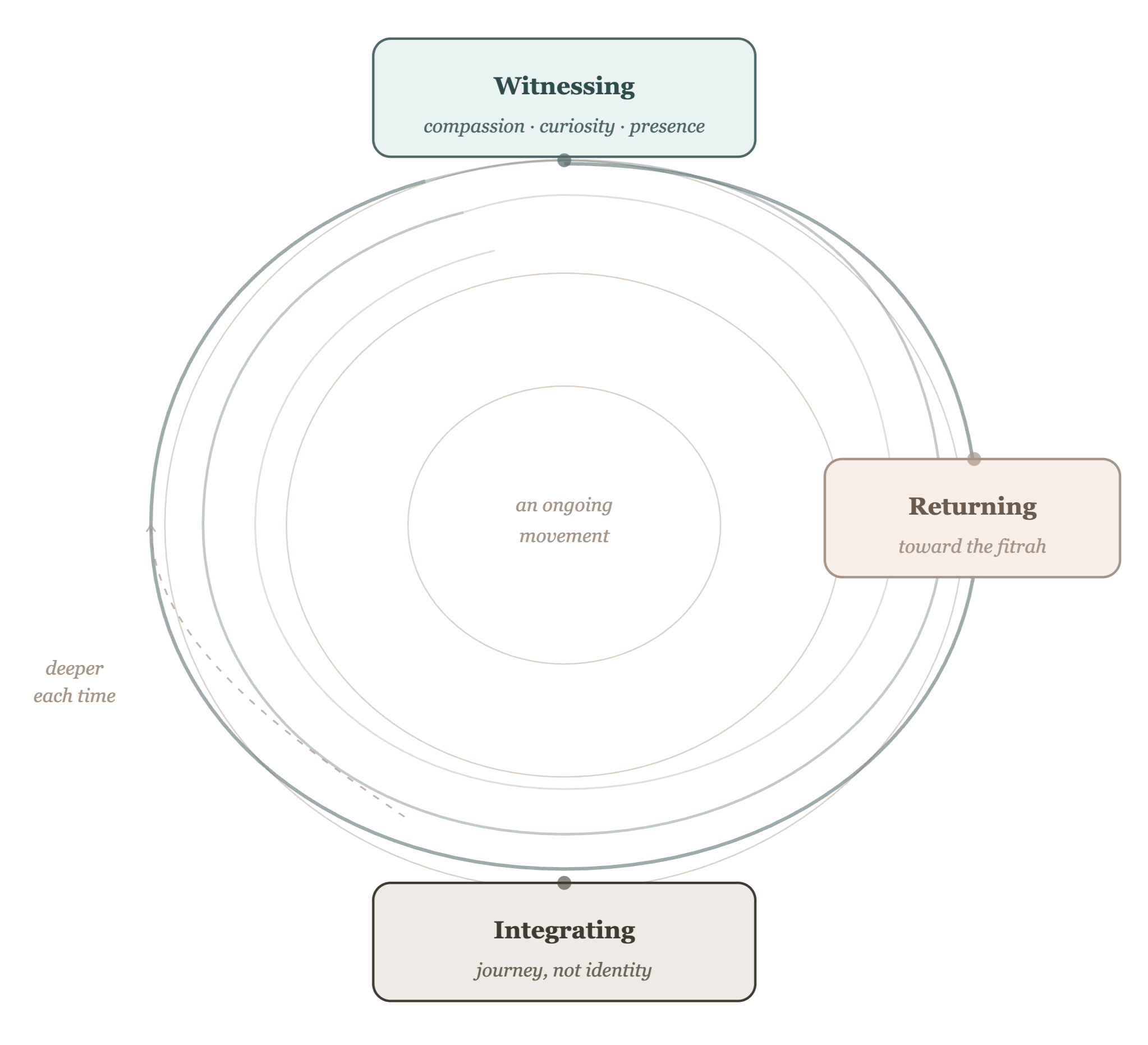
The Witnessing the Soul framework includes three types of movements — not as steps, but as ongoing rhythms of tending to the whole soul.
Witnessing
Witnessing is the practice of turning toward your own inner life — with compassion and curiosity, without judgment. Many of us have never been taught to look inward with gentleness; we either avoid what's there or meet it with harsh self-criticism. We rush past what we feel to get to God, or we shame ourselves for feeling it.
Witnessing is something different — it is the practice of actually seeing what is present within you, without needing to fix it or perform differently. It is how presence becomes possible. And it feels like gently holding in your hands what is challenging or confusing, and exploring it with compassion and curiosity. This is, in itself, a profound act of care toward the soul God entrusted to you — and it is where this orientation always begins. Witnessing requires compassion first.
Integrating
Integrating is the movement through experience — learning to hold what life brings without being defined by it. Over time, our wounds and struggles can quietly become the lens through which we see everything — ourselves, others, God, life itself. We don't always realize it's happening. What began as something that occurred to us slowly becomes the story we tell about who we are. Integrating is how the soul reclaims its larger story, making space to be shaped and even transformed by what has happened, without collapsing into it. Your struggles are part of your journey — they are not your identity. Your soul is larger than what it has been through. And the more we integrate, the more capacity we find to meet whatever comes next with greater presence and honesty.
Returning
Returning is an ongoing movement toward all that is present within you — your heart, body, mind, and spirit. Most of us have learned to live from a narrow slice of who we are, and this movement is the practice of orienting back toward the whole, again and again. It is also a return toward your fitrah — the God-given essence you were born with, which cannot be destroyed, only obscured by wounding, by protective patterns, by the noise of life. We don't always notice when we've drifted from ourselves — it happens gradually, quietly, beneath the surface of a busy life. Returning is how we recover what was always already real — not becoming someone new, but coming home to the heart. The more we practice Returning, the more we begin to recognize ourselves as a whole creation of God.
Witnessing the Soul: Key Principles
YOU ARE A SOUL FIRST
You are not a person who occasionally tends to spiritual matters. You are a soul — with a heart, a mind, a body, and a spirit — and every dimension of your life is already happening there. Most of us were never taught to live this way. We were taught to manage, to perform, to produce. The Witnessing the Soul framework begins with a different premise entirely: that the soul is not a compartment within your life. It is the center and priority of it.
THE REAL YOU IS NOT LOST
Beneath the wounding, the protective patterns, the exhaustion, and the noise — your original nature remains intact. The fitrah, the God-given essence you were born with, cannot be destroyed. It can become obscured. It can become harder to access. But it is there. The direction of this framework is not toward becoming someone new. It is toward returning to what was always there and real.
WITNESSING IS HOW WE COME HOME TO OUR SOUL
Most of us have never been taught to turn inward with gentleness. We either avoid what's inside or we judge it harshly. Witnessing is something different — it is the practice of observing your own soul with compassion and curiosity, without needing to fix or perform. It is how presence becomes possible. When we witness honestly, we begin to see ourselves more clearly — and from that clarity, something opens.
WITNESSING REVEALS CHOICE
When life feels like a strong current — when we are being carried along with no room to pause — it is often because we are living from a narrow part of ourselves. Witnessing creates space when it feels like there isn’t any. From this space, choices become visible that couldn't be seen before. This is where self-accountability becomes possible — not as demand or judgment, but as a natural expression of presence. The more we practice witnessing, the more our capacity for self-accountability deepens, emerging from the soul rather than imposed from the outside.
YOUR STRUGGLES ARE PART OF YOUR SOUL’S JOURNEY - THEY ARE NOT WHO YOU ARE
What has happened to you is real. And it is not your identity. Over time, our wounds and difficult experiences can quietly become the lens through which we see everything — ourselves, others, God, life. We don't always realize it's happening. The Witnessing the Soul framework invites us to integrate our experiences — to be shaped by it, even transformed by it — without turning them into an identity. Your soul is so much more than what you have been through.
ALL OF YOU BELONGS HERE
The heart that feels deeply. The body that carries what you’re not yet aware of. The mind that won't stop. The spirit that is longing for God. None of these are obstacles. None of them are to be transcended or suppressed or managed into silence. This orientation asks you to bring every dimension of your soul into contact with your life — your relationships, your struggles, your ordinary moments, your God. This is what presence actually looks like. Not a performance of togetherness, but a willingness to show up whole.
If something on this page has named what you've been sensing or you’re curious about what what I’ve shard means for you - I’m so glad!
Witnessing the Soul is the thread running through everything I do. It is what my therapy and guidance work is grounded in. It is what my writing, my content, and my teaching are pointing toward. And it is something I am practicing myself — imperfectly, daily, with the same compassion and curiosity I am inviting you into.
Therapy & Guidance Sessions — for what feels persistent, tender, or unmoving
Premarital Counseling — for couples who want to begin with their eyes open and their roots tended
My Book — Soulful Sexual Health for Muslims, a soul-centered guide to sexual health across the lifespan
Wherever you choose to begin, I’m honored to walk alongside you.
Where To Go From Here
About Sameera

Sameera Qureshi is a therapist, Islamic Psychology practitioner, and author of Soulful Sexual Health for Muslims (Routledge, 2025) — the first book of its kind. For eighteen years, she has supported Muslims navigating what feels stuck — emotionally, relationally, sexually, spiritually — in clinical settings, community spaces, and globally through her private practice.
Her work is grounded in the Witnessing the Soul framework — an integration of Islamic Psychology, Trauma and Somatics science, and Occupational Therapy that invites us into a more present, whole, and God-centered way of inhabiting their lives. It is practical, embodied, and rooted in the belief that the soul is not a compartment within your life. It is the center of it.
Sameera lives in Virginia with her husband.